
James Bowen BA, LLB (Univ. QLD) - full CV


Captain James Cook has landed a small party from the HMB Endeavour at Botany Bay and two Aboriginal men threaten the new arrivals with spears. Cook's party stayed at Botany Bay for a week collecting water, timber, fodder and botanical specimens and exploring the surrounding area. Cook made several attempts to establish relations with the Aboriginal people but they showed no interest in the food and gifts the Europeans offered, and occasionally threw spears as an apparent warning.
THE COMPETITION BETWEEN BRITAIN AND FRANCE TO OWN AUSTRALIA (VARIOUSLY KNOWN AS TERRA AUSTRALIS AND NEW HOLLAND IN THE 18TH CENTURY.)
To acknowledge historical reality, we must acknowledge that Terra Australis (now Australia) would have fallen under French or German colonial rule if the British had not established the first European settlement in 1788.
So little real history has been taught in Australia since the 1980s that it is likely to surprise many of its citizens to learn that Britain's First Fleet beat the French to Botany Bay in January 1788 by only six days. The armed tender ship HMAT Supply arrived at Botany Bay first on 18 January 1788. The last ship of the First Fleet reached Botany Bay on 20 January 1788. A French expeditionary force of two ships commanded by Commodore Jean-Francois de Galaup, compte de Laperouse, arrived off Botany Bay on 24 January 1788 under instructions from French King Louis XVI to claim Terra Australis (Australia), including Botany Bay, for France.
Although British explorer Captain James Cook had claimed the whole of eastern Australia for Britain in 1770, Britain's claim to eastern Australia would only be recognised by other European powers at that time if settlement had accompanied Cook's claim for British ownership. No British settlement in Australia occurred until January 1788.
Laperouse would only have needed to arrive at Botany Bay before the First Fleet and establish a rudimentary settlement to defeat a British claim to Botany Bay because it would have belonged to France.
THE INSISTENT FRENCH NEED TO ACQUIRE AND KEEP AN EMPIRE DATES BACK TO THE SEVEN YEARS' WAR 1756-1763.
The Seven Years' War (1756-1763) was a massive conflict that ranged across Europe, North America, the Carribean, and India, and it was fought primarily between Britain and France for global supremacy over the other. The war ended with France losing to Britain all of Canada, a large swathe of what is now the United States between the Appalachian and Rocky Mountains, some Carribean islands, and all military power in India.
At stake for both countries were very valuable trades, including such items as Carribean sugar, Indian silks and spices, and American furs and fish. The British government feared the result of France acquiring ownership of Terra Australis as a massive colony that straddled the Indian and Pacific Oceans would be to enable France to block or hinder British trade routes.
The Seven Years' War had left the treasuries of Britain and France exhausted, but the French were left with a burning desire to find new colonies to replace those lost in that war. King Louis XV of France turned his attention to acquiring those new colonies for France in the Indo-Pacific region.
FRENCH BOUGAINVILLE EXPLORATION IN THE PACIFIC 1766-1769.
In 1766, nobleman and distinguished soldier Louis-Antoine, compte de Bougainville, was authorised by King Louis XV to circle the globe and claim for France any available territory during that long voyage. That authorisation by the French king effectively meant claiming any territory for France not already possessed by a European power or lacking the military power to resist a claim by Bougainville whose fleet comprised only two ships. The intent to seize territory in the Pacific for France was disguised by the presence on Bougainville's ships of professional naturalists and geographers.
Bougainville's secret instructions from Louis XV included claiming Terra Australis (Australia) for France. Bougainville claimed Tahiti and the island of Bougainville in the Solomons for France but was prevented from reaching and claiming Australia for France by heavy breakers off the Great Barrier Reef. Feeling it was unsafe to risk his ships, Bougainville turned away from Australia and sailed to Batavia. The Bougainville circumnavigation of the globe ended at Saint-Malo in France on 16 March 1769 where he was proclaimed a national hero.
So Australia was saved from a French claim preceding that by Captain Cook by the forces of nature that blocked Bougainville reaching the coast of Australia.
THE APPALLING HISTORY OF FRENCH COLONIALISM SUGGESTS THAT AUSTRALIA WAS FORTUNATE TO BE SETTLED BY BRITAIN.
If French attempts to seize Terra Australis (Australia) for France had succeeded, Aboriginal Australians would have found themselves living under a much harsher regime than that of the benign British government.
The French have a long history of ruthless invasions of other countries beginning with the invasion of England by the Duke of Normandy in 1066. The French invaders took from the English their homes and lands without any compensation. During the Napoleonic Wars (1803-1815) most of the countries of Europe were invaded and conquered by the troops of French Emperor Napoleon Bonaparte. His French troops were allowed by him to slaughter, rape, and loot without any concern shown by him for the suffering produced by French invaders of the European countries brought under French rule by conquest.
The French people have remained proud of the empire that Napoleon gave them by ruthless conquest and have never forgiven Britain for the defeat of Napoleon by the British Duke of Wellington at the Battle of Waterloo in 1815 that stripped France of its stolen empire.
Driven by their insistent demand for empire to replace the lost Europe-wide conquests of Napoleon, in 1830 the French turned to invading and seizing counries in Africa that were not already owned by a European power or lacked the military power to defend against French conquest.
In 1830 the French invaded and annexed Algeria which had a developed Arab civilisation. French rule brought ruthless displacement of the Arab population from their cities and towns and replacement by French settlers. The French also inflicted disease, starvation, and death upon those Algerians who resisted the French invasion of their country. Algerian resistance to the French invasion finally led to the bloody Algerian War in 1954. As many as one million Algerians and French military died in this war which saw the brutality of French repression of Arab resistance alienate most of the world from supporting the French cause. The Algerians finally ousted the French in 1962.
In 1862, again driven by the insistent French demand for empire, France invaded and annexed the Nguyen kingdom of Cochinchina in South-east Asia. The French expanded this extension of empire by invading all of what we know today as Vietnam, Cambodia and Laos. The annexed kingdoms were consolidated under French rule and assigned the name French Indo-China. In 1946, the Vietnamese rebelled against French rule and bloody warfare continued until the comprehensive French defeat at the Battle of Dien Bien Phu in 1954. The kingdoms of Camboda and Laos immediately declared their independence from France, and in that same year the French surrendered all of French Indo-China to its own people.
In 1881 the French invaded and took possession of Tunisia which had a developed Arab civilisation. The Tunisian people achieved their freedom from French rule in 1956.
In 1912, France and Spain invaded and divided the kingdom of Morocco between them. The Moroccans resented colonisation of their country, and after continuing revolts against French/Spanish rule, Morocco achieved independence and reunification in 1956.
Unlike the British who readily surrended their colonies after World War II, the French are obsessed with dreams of world-wide empire and have clung to their remaining colonies throughout the world.
This historical record of ruthless French invasion and colonisation should persuade us that Australia was fortunate to escape French rule in 1788.
CAPTAIN JAMES COOK CLAIMED EASTERN TERRA AUSTRALIS (NOW AUSTRALIA) FOR BRITAIN IN 1770.
 Captain James Cook RN.
In 1768, then Lieutenant James Cook sailed from England in command of HMB Endeavour for the ostensible purpose of travelling to Tahiti with scientists on board to study the transit of Venus across the sun at Tahiti, but his secret Admiralty instructions were to locate the supposed great southern continent Terra Australis (Australia) and claim it for Britain. The voyage was commissioned by King George III with the support of Britain's Royal Society. King George personally contributed £4,000 towards the cost of the voyage. One very important person on Endeavour was naturalist Joseph Banks, later to be Sir Joseph Banks and good friend of King George III.
At Cook's time Terra Australis was referred to as New Holland by association with landings on the the northern, western, and southern coasts of Terra Australis by Dutch explorers in the first half of the 17th century.
The Dutch East India Company ship, Duyfken, captained by Willem Janszoon, made the first documented European landing on Terra Australis in 1606. This landing was made near present-day Weipa in the Gulf of Carpentaria. Janszoon reported that the area was swampy and the native people hostile. The Dutch continued to explore Terra Australis in the first half of the 17th century, and in 1642 Abel Tasman reached what is today known as Tasmania (but called by him Van Dieman's Land). On his second voyage in 1644, Tasman explored the northern coast of Terra Australis and assigned the continent the name New Holland.
These Dutch explorations usually originated from Java which was then part of the Dutch East Indies colony, but the Dutch made no attempt to colonise the continent named by them New Holland which they viewed as unsuitable for settlement and offering no opportunities to gain wealth from trade.
The need for secrecy concerning British plans to acquire Terra Australis was necessary because France and Britain had gone to war repeatedly in the 18th century over possessions in North America, the Caribbean, Africa, and India.
After completing the observations of the transit of Venus, Cook opened his sealed orders and found that he was to sail broadly southwards for the purpose of finding Terra Australis and claiming it for Britain. On 9 August 1769 Cook weighed anchor and sailed south for about 2,400 kilometres but found no new continent; so in accordance with his instructions, he steered Endeavour west in the direction of New Zealand.
After circumnavigating the northern island of New Zealand and realising that it was not Terra Australis, Cook continued westwards. On 19 April 1770, Endeavour reached the south-east coast of Terra Australis off a coastal headland that we know as Point Hicks (State of Victoria) and ten days later Cook anchored at Botany Bay just a short distance south of what is now Sydney Harbour. Cook charted the whole of the east coast to Cape York where on the highest point of Possession Island on 22 August 1770 he formally claimed eastern Terra Australis for Britain naming it New South Wales.
Cook would return to Britain and recommend Botany Bay as the site for a new British settlement in Terra Australis. This was the first of three important steps that would lead to Britain achieving sovereignty over the whole of what is now Australia.
FRENCH INTEREST IN CLAIMING AUSTRALIA FOR FRANCE FINALLY PROVOKED BRITISH ACTION TO ESTABLISH A COLONY AT BOTANY BAY.
Despite Captain James Cook having claimed all of eastern New Holland for Britain, the British government initially showed no interest in establishing a colony at Botany Bay. Almost sixteen years passed before the British government showed interest in such a massive colonial enterprise. The precipitating factor was information provided to the British government that the French were intending to establish a French colony at Botany Bay.
We can thank research by Margaret Cameron-Ash for uncovering and disclosing the precipitating factor that led to establishment of a British colony at Sydney in 1788. She reveals the reason for the sudden interest of the British government in establishing a colony on the eastern coast of New Holland in her book "Beating France to Botany Bay - The race to found Australia".
THE FOLLOWING EXTRACTS ARE DRAWN FROM "BEATING FRANCE TO BOTANY BAY - THE RACE TO FOUND AUSTRALIA"

"Although claimed to be, convicts were not the reason for the expensive antipodean colony, but they were vital to the success of the Botany Bay campaign. They provided a critical mass of travel-ready occupiers at a time when Eurocentric law required actual occupation, not just a flag-waving visitor, to secure title to new lands. The convicts also provided cheap labour for the term of their sentence (after which they were eligible for a grant of land). Consequently, Australia is the only continent free from the legacy of slavery. Finally, the convicts provided the all-important smokescreen: the world would see that Britain was merely ridding itself of derelicts; it was not reaching to extend its empire to the far side of the globe.
The Botany Bay decision, made suddenly and unexpectedly on August 18, 1786, was arguably the most significant decision made by George III and by Prime Minister Pitt during their incumbencies. Secrecy was paramount, so documentation is minimal.
Still, there is sufficient evidence to show that the aim of both men was to shape the geopolitics of the globe. The imperial struggle between Britain and France had shifted from North America to the Pacific, where the continent of New Holland was, in the words of Bernard Smith, waiting to be “possessed and filled”. The rise and fall of Europe’s maritime empires meant that the remaining contenders were France, the absolutist monarchy, and Britain, the democratic, constitutional monarchy.
At stake were two prizes which Britain could not afford to surrender to the enemy. The first was a land mass strategically placed at the south-west corner of the Pacific Ocean. The second, unknown to the French, was Port Jackson—the finest natural harbour in the world.
Captain Cook had seen this naval paradise when he hiked overland from Botany Bay and gazed out over the vast southern arm of the inlet, now known as Sydney Harbour. He carefully omitted it from his journal and charts but told Philip Stephens at the Admiralty on his return. The documentary evidence of Cook’s discovery is not to be found in the Admiralty archives. As de facto chief of the Secret Service, Stephens knew not to commit such critical intelligence to paper. The evidence is, however, held in the archives of the Home Office at Kew. In a memo discussing his draft instructions from Lord Sydney in 1787 (see my book "Lying for the Admiralty", Quadrant Books, pp 285–86), Arthur Phillip revealed he had been apprised of the geography and islands deep inside Port Jackson.
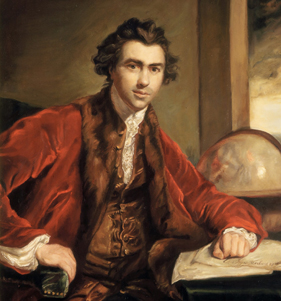 Sir Joseph Banks
Before examining King George III’s role in the founding of modern Australia, we should look at the role played by his friend and confidant Joseph Banks. The two men met soon after Captain Cook’s Endeavour returned to England in 1771 when Banks was presented to the King during the Friday levee at St James’s Palace.
Banks (soon) became a close friend and adviser to the King and Queen in a private association that lasted forty years….
During his regular conversations with the King, Banks would have told him of the shock he and Cook received in Batavia during Endeavour’s homeward leg. There they learnt that the French navigator Louis Bougainville had traversed the Pacific a year ahead of them and annexed numerous islands and coasts. Indeed, Louis XV had instructed Bougainville to investigate Van Diemen’s Land, New Holland and Carpentaria because 'it can only be in France’s interest to survey them and take possession of them should they offer items useful to her trade and her navigation'.
Luckily, New Holland had not been caught in Bougainville’s net on that voyage, but Banks knew the French would try again. He embarked on a long campaign to persuade the British government to occupy Australia before France did.
(Banks) was certain that a threat from France would jolt Whitehall into action. He may have expected that the departure of Laperouse’s two vessels on August 1, 1785, would cause a flurry at the Admiralty, but it didn’t. A year passed as the French “scientific” expedition rounded Cape Horn and began plying the Pacific.
Banks needed a catalytic event that would produce compelling evidence that France intended to seize Australia. Extraordinarily, this evidence was provided by the US Ambassador in Paris, Thomas Jefferson.
While Whitehall was not bothered by Laperouse’s departure for the Pacific, Jefferson was. He suspected that Louis XVI intended to plant French colonies on America’s west coast. He sent a letter to John Paul Jones, who was then in Brittany, asking him to spy in the port of Brest, where Laperouse’s ships were being fitted out. Jones did so, then sent a remarkably thorough report to Jefferson on October 5, 1785.
Jones’s letter revealed that France was planning to plant new colonies, but not in North America. According to Jones, one of Louis XVI’s “Objects in View [is] … to establish Colonies in New Holland”. For greater insight, Jefferson discussed Jones’s letter with his closest friend in Paris, John Ledyard of Connecticut. Ledyard had sailed the Pacific with the late Captain Cook’s third voyage in search of the Northwest Passage.
Ten months after reading Jones’s letter, Ledyard happened to travel from Paris to London. On Thursday August 17, 1786, he met Sir Joseph Banks (a fellow Cook alumnus) and told him the vital piece of intelligence obtained by Thomas Jefferson.
As Banks hoped, John Ledyard’s message that France was poised to colonise Australia jolted the Prime Minister into action and the cabinet meeting was arranged for the following morning.
The next day, Friday August 18, William Pitt’s cabinet famously decided to send a Royal Navy Task Force to occupy Botany Bay immediately....…at midday on Saturday, a despatch rider was sent to Windsor with the document setting out the cabinet’s final resolution. George III signed it, indicating his approval for the Botany Bay campaign, and sent the messenger back to London so that Whitehall could get started immediately.
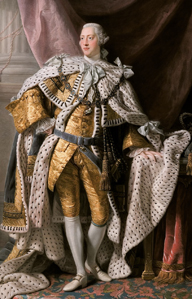 George III
George III was more than just an armchair traveller. He understood that Britain was a small island whose lifeblood was trade along the world’s superhighways of the high seas. His kingdom’s military and commercial survival depended on sea lanes, trade routes and geopolitics. He understood the geographic importance of New Holland in a world without the Suez and Panama canals.
Parliamentary approval for the plan was obtained on the passing of the New South Wales Courts Act 1787, guaranteeing “a colony and a civil government”, to which the King gave his royal assent on February 23. The Act was implemented on April 2 by the Charter of Justice, Letters Patent which established a Court of Civil Jurisdiction and a Court of Criminal Jurisdiction. There would also be an Admiralty Court.
After the announcement of the departure date, Captain Arthur Phillip was summoned to St James’s Palace. Here, on January 3, 1787, he was presented to George III by Lord Sydney in a formal and, no doubt, heartfelt leave-taking. The historic convoy, later known as the First Fleet, sailed from Portsmouth in May 1787.
On learning of the British manoeuvre, the French Minister of Marine, Charles Castries, drafted new instructions for Laperouse, ordering him to abandon his itinerary and go straight to Botany Bay (below). This despatch was sent from Paris to Moscow, then taken by courier across Siberia. Laperouse received it at Petropavlovsk in Kamchatka in late September 1787. He sailed south immediately and reached Botany Bay on January 23, 1788. There he found Arthur Phillip, who had arrived five days earlier.*
* JKB COMMENT: As a graduate historian from an era when history was not just a collection of themes, I prefer the arrival date of Laperouse at Botany Bay as being 24 January 1788 and mention that Laperouse did not ever meet Arthur Phillip who was away investigating what we know as Sydney Harbour.
It is not difficult to see why George III and William Pitt made the snap decision to occupy Australia when confronted with Thomas Jefferson’s news. As Geoffrey Blainey wrote in his renowned book The Tyranny of Distance in 1966, “it was simply vital that France should not be allowed to occupy such a strategic site”.
If France had succeeded in any of its plans to take Australia, the eastern hemisphere would be a very different place. The French administration would have collapsed under France’s doomed absolutist monarchy and the ensuing chaos of the revolution.
New Holland would likely have become a patchwork of nations riven by differences of language, interests, commodities, wealth and religions. Instead, serendipitously, the Commonwealth of Australia is a free, unified, stable, flourishing, English-speaking democracy."
JKB COMMENT: Anyone seriously interested in the history of Australia should buy this book by Margaret Cameron-Ash which is published by Quadrant Books. I also recommend her other history of the founding of Australia "Lying for the Admiralty" which also focusses on Captain Cook.
BRITAIN CHOOSES ROYAL NAVY CAPTAIN ARTHUR PHILLIP TO ESTABLISH A BRITISH SETTLEMENT AT BOTANY BAY.
The British Secretary of State, Lord Sydney, accepted Captain Cook's recommendation of Botany Bay as the site for the new British settlement and chose Captain Arthur Phillip of the Royal Navy to lead what is now called the "First Fleet" which comprised two Royal Navy ships, three store ships, and six convict transports. When the settlement was established at Botany Bay, Captain Phillip would be the first governor of the new colony. The presence of women and children in the First Fleet indicates very clearly that a need for military action at Botany Bay was not contemplated by the British government.
 Governor Arthur Phillip RN
Prior to his departure for Botany Bay in 1787, Phillip received his Instructions (composed by Lord Sydney) from King George III. The Instructions included Phillip's Commission as Captain-General and Governor-in-Chief of the new colony to be called New South Wales. The Instructions advised Phillip about managing the convicts, granting and cultivating the land, and exploring Terra Australis. The Aborigines' lives and livelihoods were to be protected and friendly relations with them encouraged:
"You are to endeavour by every possible means to open an Intercourse with the Natives and to conciliate their affections, enjoining all Our Subjects to live in amity and kindness with them. And if any of Our Subjects shall wantonly destroy them, or give them any unnecessary Interruption in the exercise of their several occupations. It is our Will and Pleasure that you do cause such offenders to be brought to punishment according to the degree of the Offence.
And whereas We are desirous that some further information should be obtained of the several Ports or Harbours upon the Coast and Islands contiguous thereto within the limits of Your Government; you are, whenever the Sirius or the Supply Tender, can conveniently be spared, to send one, or both of them, upon that service.
Norfolk Island...being represented as a spot which may hereafter become useful, you are, as soon as circumstances will admit of it, to send a small Establishment thither to secure the same to us, and prevent its being occupied by the subjects of any other European Power."
The last two paragraph's of Phillip's instructions reflect Britain's concern that the French might attempt to establish bases elsewhere on the eastern coast of New South Wales.
Finding Botany Bay unsuitable for growing crops, Captain Phillip moved the new colony north to Port Jackson (Sydney), and the British settlers landed at an area of the harbour to be called Sydney Cove (after Lord Sydney).
THE FRENCH LOSE A LAWFUL CLAIM TO BOTANY BAY AND AUSTRALIA BY ONLY SIX DAY.S


Laperouse showed no haste to reach Botany Bay. After rounding Cape Horn, his squadron called at Hawaii, Alaska, California, Macau, Manila, and finally Petropavlovsk in Russian Siberia. Here Laperouse received the alarming news that Britain had despatched a fleet to establish a settlement at Botany Bay. This would frustrate the French plan to seize Botany Bay as the first step in French ownership of the whole of Terra Australis. Laperouse was ordered to reach and claim Botany Bay for France before the British fleet arrived.
One year after the visit by Laperouse, the French Revolution occurred and any French settlements in Australia would have had the gulilotine established for efficient execution of troublemakers during the terror that engulfed France during the course of the revolution. The French Revolution was followed in France by Napoleon Bonaparte who did not discourage his troops from murdering, raping, and pillaging in every new country invaded by France.
If the French had planted bases on the eastern coast of Australia, as planned by King Louis XVI, Australia would likely still be a massive French colony perhaps with the status of French New Caledonia and French Polynesia.
THE LANDING OF THE FIRST FLEET AT SYDNEY COVE ON 26 JANUARY 1788.
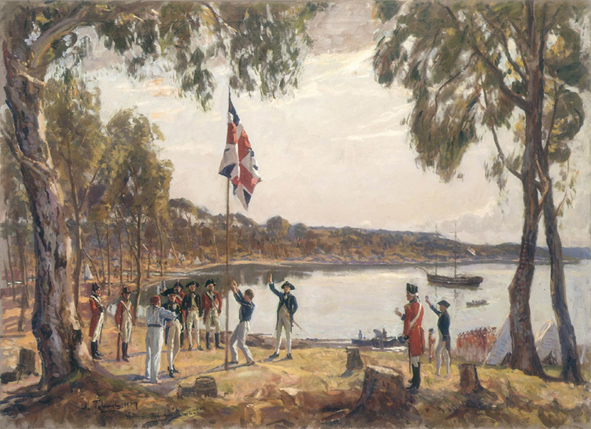
The British flag is raised in a formal ceremony in the presence of Governor Arthur Phillip at Sydney Cove on the evening of 26 January 1788. Those present are raising their glasses to toast the king and queen. Local Aborigines appeared to show little interest in the new arrivals. Painting by Algernon Talmage RA.
JKB NOTE: An appreciation of the founding of Australia at Sydney on 26 January 1788 would be greatly assisted by reading two classic accounts of the arrival of the First Fleet and the development of the colony of New South Wales over its initial years. Those accounts were written by well-educated British Marine officer Lieutenant Watkin Tench who travelled as a member of the First Fleet aboard the transport Charlotte and who is best known for publishing two accounts of the first four years of the settlement at Sydney Narrative of the Expedition to Botany Bay (1789) * and A Complete Account of the Settlement at Port Jackson (1793) *. His detailed accounts include his friendships with Aboriginal people one of whom we know as Bennelong. Schoolteachers who falsely tell their classes that the arrival of the First Fleet was an invasion that produced violent dispossession of Aborigines are likely to ignore these books because they are proof of such a lie. * Both books are available from Amazon in Kindle format at negligible cost

Days have passed and this so-called "invasion" has produced no hostility between British settlers and Aborigines. The only hostility was to occur in 1790 when one Aborigine wounded Governor Arthur Phillip with a thrown spear. Following the strict orders of the British government to "live in amity and kindness" with the Aboriginal people, Phillip responded by ordering no retaliation against the Aborigine who wounded him.
THE READING OF A PROCLAMATION BY GOVERNOR ARTHUR PHILLIP ESTABLISHED BRITISH SOVEREIGNTY OVER EASTERN AUSTRALIA
On 25 January 1788 Captain Arthur Phillip aboard the armed tender HMAT Supply anchored off Sydney Cove, a small bay inside Port Jackson that is today’s ferry hub at Circular Quay. The rest of the First Fleet remained at Botany Bay having arrived there on 18 January, a week before, and would follow the Supply into the cove the next day.
On the evening of 26 January 1788 the crew of the Supply gathered to toast the King, the Royal Family and the success of the colony, hoisting a banner up a newly planted flag pole.
The landing was entirely peaceful. No Aborigines appeared to contest the landing.
When basic accommodation for members of the First Fleet had been established ashore, the formal documents proclaiming the new colony were read aloud by new Governor Arthur Phillip on 7 February 1788 at a ceremony declared a public holiday and enlivened by music and bunting. This formal proclamation marked the beginning of British sovereignty over the new colony of New South Wales. The Aboriginal inhabitants of the Port Jackson area appeared to find no interest in the colourful ceremony because none came to watch it.
Governor Arthur Phillip remained in Sydney from the landing of the First Fleet to his departure for England for medical treatment on 11 December 1792. The only recorded act of violence involving Aborigines during his time as governor of the new colony was directed solely against Phillip.
This violent act occurred on 7 September 1790 when Governor Phillip landed in a small boat with a small crew on the northern shore of the harbour at what is now called Manly Cove. While communicating with an Aborigine known to the settlers as Baneelon (Bennelong), and in the presence of a large group of several hundred Aborigines that included women and children, one Aborigine threw a spear that wounded Phillip in the shoulder. This Aborigine then ran off into the bush. None of the other Aborigines present at the scene showed any hostility towards the governor's small party.
Following the strict orders of the British government to "live in amity and kindness" with the Aboriginal people, Phillip responded by ordering no retaliation against the Aborigine who wounded him.
Many children are taught in Australian schools that an invasion occurred on 26 January 1788 that cruelly dispossessed Aboriginal people of their lands; but this is a cruel lie that appears to be intended to cause Australian children to feel guilt that they are living on stolen land.
No land was stolen from Aboriginal people by British settlers who landed peacefully at Sydney Cove on 26 January 1788. Governor Phillip spent more than three years searching for Aboriginal people to fulfil his instructions from King George "to live in amity and kindness with (the Aboriginal people)"; but he was able to locate and befriend only a very small number of Aborigines whose names included Bennelong (Baneelon), Arabanoo, and Nanbaree. Aboriginal people would appear in large numbers from time to time and gratefully accepted gifts, including much valued hatchets, from Governor Phillip; but Phillip wanted to speak to Aboriginal chiefs so that he could invite the Aboriginal people to resume their traditional hunter/ gather activities around Sydney Harbour. The Aboriginal people had not reached the stage of human development that produced tribal chiefs, so Phillip was frustrated in his attempts to form friendships with the Aboriginal tribes.
Another aspect of the invasion lie is the fact that it is not possible to invade in any meaningful sense of that word a country that lacks any form of sovereignty because its occupants are wandering nomads without any leaders. I explain elsewhere why the Aboriginal occupants of Australia in January 1788 lacked any form of sovereignty over Australia.
Finally, and conclusively, the High Court of Australia has twice rejected any suggestion that Australia was invaded by conquest on 26 January 1788, and declared that the British arrival at Port Jackson on that date was settlement.* It is very likely that the British government was acting to settle people at Botany Bay based upon a common law principle set out in the famous four volume treatise “Commentaries on the Law of England” (1765-1770) produced by the eminent British jurist and judge Sir William Blackstone. Blackstone spoke of the British common law being introduced to lands that were “desert and uncultivated” when peacefully annexed as a British dominion by settlement. By “desert”, Blackstone was not referring to vast sandy Sahara-like stretches but lands without settled inhabitants or settled land as Captain Cook found Terra Australis in 1770.
* In Coe vs. The Commonwealth (1979) 24 ALR 118, Chief Justice Gibbs said: “It is fundamental to our legal system that the Australian colonies became British possessions by settlement and not by conquest.” In Mabo v. Queensland No. 2 (1992) the six majority judges did not change that view, and accepted that Australia was settled and not invaded in January 1788. If Australia had been invaded by conquest in 1788, Native Title could not exist. Those who foolishly talk about invasion in 1788 should think about that.
British settlers found on their arrival at Sydney Cove on 26 January 1788 that Aboriginal people were nomadic and tended to avoid contact with them. Aboriginal numbers across the continent then known in Europe as Terra Australis are not accurately known but believed to have been somewhere between 350,000 and perhaps one million.
The British settlers found no Aboriginal towns or villages; no buildings of any kind or fences; no roads or even established paths; no knowledge of agriculture; no knowledge of writing; and no ability to create clothes, to build even a primitive hut for shelter, or create a bow and arrow to hunt for food. Hunting for food was usually carried out with a thrown spear as shown in the image below.

Over 60,000 years of Aboriginal occupation of what was then called on European maps "Terra Australis" Aboriginal technology had not developed past the use of Stone Age tools such as stone axes (see image above) and chipped stone knives. They wore no clothes (see second image above where normal Aboriginal genital exposure has been obscured using Photoshop) but draped themselves with animal skins for warmth when necessary. Fire was produced by rubbing sticks together. They built no houses. Temporary protection from bad weather was produced by clumping brush as shown in the image above, and it would be blown away by the first strong wind.
The Aborigines in 1788 knew nothing about growing crops for food. The Aboriginal women simply gathered natural plant food from the earth and native vegetation. These characteristics of Australian Aborigines, as observed by Captain Cook and Captain Arthur Phillip, necessarily place their development as human beings in the Paleolithic or Old Stone Age.
There was no form of government of Aboriginal tribes in the sense that Western countries know it. Aboriginal tribes in 1788 had no chiefs. They resembled a form of gerontocracy in which older initiated men provided advice and control in tribal matters.
It was not unusual for Australians educated in the 1940s and 1950s to be told that life in Aboriginal tribes was often harsh, especially for women and young girls. Political correctness now permits only Aboriginal women to mention these matters. However, Marine Lieutenant Watkin Tench provides us with a glimpse of this observed harshness of Aboriginal males towards women of their tribes in his journal of his four years at Sydney Cove from 1788 to 1792:
"the women are in all respects treated with savage barbarity; condemned not only to carry the children, but all other burthens, they meet in return for submission only with blows, kicks, and every other mark of brutality. When an (Aborigine) is provoked by a woman, he either spears her, or knocks her down on the spot: on this occasion he always strikes on the head, using indiscriminately a hatchet, a club, or any other weapon, which may chance to be in his hand." From A Complete Account of the Settlement at Port Jackson (1793).
The Uluru Statement offers Aboriginal tribal culture to Australians as a "gift". Observations of that tribal culture by intelligent observers since British settlement in 1788 can be VIEWED here - and are likely to be of particular interest to Australian women.
Words such as Aboriginal "dispossession" and "stolen land" are bandied about by leftist historians and Aboriginal activists, but these words ring false when we know that the Aboriginal people in 1788 were nomadic hunter-gatherers whose lifestyles placed them in a very early stage of the Paleolithic era or Old Stone Age. They had not learned to create clothing and roamed naked except for draped animal skins when warmth was needed. They built nothing permanent for shelter and simply followed the movement of animals they needed to kill for food. The only evidence of their having been present hunting in any particular place was perhaps a footprint, chewed and discarded animal bones, and dead campfires.
Nomadic Aborigines who frequented the area around Port Jackson for hunting and plant food gathering would have suffered inconvenience from the British settlement in 1788, but they lost access to their traditional hunting and food gathering lands around Port Jackson because they elected to avoid the British settlement and not because they were driven from Port Jackson. If their social development had reached the point of electing tribal chiefs, those chiefs would have been warmly welcomed by Governor Phillip who, in accordance with his strict instructions from London to "live in amity and kindness" with the Aboriginal people, would have assured them that they could continue to hunt and gather food at Port Jackson as long as they did not spear the settlement's domesticated animals.
The First Fleet brought a small flock of sheep to Australia, and their numbers increased rapidly with every new arrival from Britain. Australia offered good pastures for sheep, and allocation of land for sheep farming soon required expansion of the initial settlement at Sydney.
As British settlement extended further from Port Jackson, friction often developed between white settlers and Aborigines. Animal and vegetable foods could be found for the taking by Aboriginal nomads anywhere across thousands of kilometres of forest and scrub lying south, west, and north of the British settlement at Port Jackson, but it appears that the Aborigines found the spearing of sheep and other domestic animals belonging to settlers easier than chasing fleet-footed kangaroos.
The size of sheep properties required the use of shepherds who were often located in huts distant from the owner's farmhouse. These shepherd's huts were an attractive target for small groups of Aboriginal maraunders. Shepherds were often speared and their huts pillaged for food, liquor, tobacco, clothing, weapons, tools and anything else that could be readily carried off.
As a result of such spearings of shepherds, domestic animals, and at times the settlers themselves, violent local conflicts occurred frequently in the form of retaliation against Aborigines living nearby. A ridiculous practice has developed on the part of some Australian pseudo historians who have been describing these limited local conflicts as "frontier wars" despite the fact that these local conflicts bore no resemblance to what rational people would perceive a war to be.
The colonial military were sometimes called upon in small numbers to help police keep the peace between settlers and Aborigines but these were never more than very small scale interventions bearing no resemblance to real wars.
Historical fact shows that so-called "Frontier Wars" were invariably settlers defending their homes and sometimes their lives against hostile depredations by small Aboriginal groups whose motivations were usually theft of food, domestic animals, and anything that could be readily carried off. As Geoffrey Blainey has affirmed in "A shorter History of Australia" many Aborigines actually clamoured for British goods including iron, flour, sugar, tobacco and rum".
Those acts of serious violence between settlers and usually very small groups of tribal Aborigines were totally unsanctioned by the Colonial government in Sydney. Those governments in Sydney permitted no warfare against Aboriginal people of the kind that marred the history of relations between United States governments and American Indians.
The claims to eastern Australia by Captain Cook and Captain Arthur Phillip were not made by reference to the concept of "terra nullius" as six of the seven judges of the High Court mistakenly believed in Mabo v. Queensland (1992).
"Terra nullius', in correct translation from the Latin means "land belonging to no one". "Terra nullius" is now widely and incorrectly believed to mean a land that is unoccupied by human beings, and the majority High Court judges appear to have mistakenly thought that "terra nullius" had this meaning. Common sense would immediately suggest that judges should not stray into little-known Latin phrases when they have no depth of understanding of Latin.
Through faulty understanding of history and the Latin language, “terra nullius” was inappropriately introduced by the majority judges in Mabo to explain the British government’s justification for settlement in Australia in 1788.
It is highly unlikely that the British government was even aware of the term “terra nullius” in 1788 because it only became recognised by public international law in the late 19th century as meaning land that has never been subject to the sovereignty of any state, or over which any prior sovereign has expressly or implicitly relinquished sovereignty.
It is very likely that the British government was acting to settle people at Botany Bay based upon a common law principle set out in the famous four volume treatise “Commentaries on the Law of England” (1765-1770) produced by the eminent British jurist and judge Sir William Blackstone. Blackstone spoke of the British common law being introduced to lands that were “desert and uncultivated” when peacefully annexed as a British dominion by settlement. By “desert”, Blackstone was not referring to vast sandy Sahara-like stretches but lands without settled inhabitants or settled land as Captain Cook found Terra Australis in 1770.
AUSTRALIAN ABORIGINES IN 1788 WERE NOMADS WHO HAD ONLY DEVELOPED TO THE PALEOLITHIC OR OLD STONE AGE AND WERE LEGALLY INCAPABLE OF EXERCISING SOVEREIGNTY OVER AUSTRALIA.
A view has been pursued by Aboriginal activists for several decades that some form of Aboriginal sovereignty over Australia somehow existed in 1788, and has never been "ceded or extinguished"* despite British settlement of eastern Australia in 1788 and British acquisition of total sovereignty over Australia with the creation of the colony of Western Australia in 1827. * See Uluru Statement.
This view is fanciful and betrays a total misunderstanding of sovereignty under international and territorial law. Sovereignty cannot exist without government, and nomadic Aboriginal tribes in 1788 had no form of government. Aboriginal tribes did not even have chiefs.
The Western Sahara case before the International Court of Justice denies the claim to sovereignty over Australia by Aborigines at the time of British settlement in 1788.
The existence of any rights of nomads in relation to lands over which they roamed was not recognised by international law until the United Nations referred the issue of claims of sovereignty over the Western Sahara to the International Court of Justice (ICJ) in 1975.
In the Western Sahara case, the ICJ was asked for an advisory opinion in relation to a territorial dispute between Morocco and Mauritania as to ownership of the Western Sahara. The Western Sahara was originally colonised by Spain, and nomad tribes roamed the Western Sahara at the time of colonisation and the time of the ICJ judgment.
Although not directly relevant to its judgment, the ICJ gave some thought to the question whether nomadic tribes possessed any rights in relation to the lands over which they roamed.
The ICJ found that:
‘the nomadism of the great majority of the peoples of Western Sahara at the time of its colonization gave rise to certain ties of a legal character.... The tribes, in their migrations, had grazing pastures, cultivated lands, and wells or water-holes in both territories, and their burial grounds in one or other territory. These basic elements of nomad’s way of life….were in some measure the subject of tribal rights, and their use was in general regulated by customs.’
The ICJ advised that nomadic tribes should be ‘considered as having in the relevant period possessed rights, including some rights relating to the lands over which they roamed’, but the ICJ did not accept that under international law nomadic tribes could possess a sovereign right of ownership of those lands.
Although an advisory opinion and not binding, the Western Sahara case clearly offers no support to the claim made in the Uluru Statement that Aboriginal Australians possessed any form of sovereignty over Australia at the time of British settlement in 1788.
The Aboriginal claim for sovereignty over Australia also gains no support from the High Court in Mabo v. Queensland (1992). In this case, the High Court accepted that annexation of the Meriam Islands in the Torres Strait by Queensland in 1878 left no sovereignty in the native people of those islands.
British settlement brought to Terra Australis parliamentary democracy, the rule of law, and equality before the law. Every Australian enjoys access to education, health care, and welfare support from the cradle to the grave. All of these things are enjoyed by every Australian including Aborigines and those with Aboriginal ancestors.
British settlement also brought to Australia all the advantages of one of the world's great civilisations, including science, medicine, technology, travel for pleasure, art, literature, music, animal husbandry, and agriculture.
ABORIGINAL AUSTRALIANS ENJOY ALL THE BENEFITS OPEN TO EVERYONE IN AUSTRALIA - AND THOSE BENEFITS DRAW MIGRANTS FROM EVERY CORNER OF THE WORLD
Australian Aborigines and those with Aboriginal ancestry can enjoy not only these benefits of Western civilisation, but also special privileges not available to the ninety-six percent of Australians who lack Aboriginal ancestry. Those privileges included preferment in public service employment, large private companies, and education, especially tertiary education.
In addition to the benefits enjoyed by all Australians, governments at Federal and State levels spend more than 30 billion dollars each year solely to advance the well-being of Aboriginal Australians. There can be no doubt that Australians with Aboriginal ancestry have won extraordinary benefits from British settlement in 1788.
For another view, we can turn to the so-called Warriors of the Aboriginal Resistance (see below) who include in their fancied claims of unjust treatment of Aboriginal Australians that Aboriginal wealth was stolen by British settlement in 1788. How wealth could possibly be stolen from nomadic hunter-gathers who built nothing on the land surface of Australia is convenienty ignored when preaching hatred. One could almost guarantee that many of these haters of present-day Australia benefit from taxpayer-funded welfare payments and free health care.


LEFT: So-called "Warriors of the Aboriginal Resistance" declare war on the Australians who provide them with their welfare benefits; CENTRE: This is what the Uluru Statement is all about, namely, the Aboriginal demand for ownership of the whole of the Australian land mass; RIGHT: Aboriginal protesters sit down across a major Melbourne city intersection to block people who actually work returning to their homes at the end of the day.
These so-called "Warriors" appear to want wealth that did not exist in 1788 handed over to them so that they do not have to work themselves in the way that migrants worked who came with little in their pockets from war-ravaged Europe after 1945. The eleven Australians of Aboriginal descent in the Australian Parliament did not have these high offices simply handed to them. They worked to achieve high office in ways that would probably be impossible for the "Warriors" to understand or match.
For an objective viewpoint, we could turn to the distinguished British historian and social analyst Paul Johnson who, after his visit to Australia in the 1990s, concluded:
"The development of Australia rates as one of mankind's great achievements. With five years to go before the double century, one of the most advanced and prosperous societies on earth has been created. It is an achievement with few parallels in the history of human adventure. In the sixties the phrase "the lucky country" was coined. In fact there was little luck. Nothing but hard sweat and peril - in the process whereby, for instance, poor men pushed broad-wheeled barrows hundreds of miles along a burning coastline to open up the Australian goldfields. There are far more tales of heroism and sacrifices in the penetration of the Australian outback than in the whole history of the American Far West".
If the British or French had not been first to establish colonies in Australia, the Germans would almost certainly have done so. The German colonies in Africa were notorious for cruel and genocidal treatment of the native peoples. Fortunately, for Australian Aborigines, the Germans did not get closer to Australia than establishing the colony of German New Guinea.
French and Germans colonists did not have explicit instructions from their governments to treat native people in their colonies with kindness, whereas Captain Arthur Phillip had explicit instructions from Britain to treat the native people in the newly founded colony of New South Wales with kindness.